Throughout his campaign, Donald Trump railed on the US education system, saying that our students are performing “at the bottom,” and “we can’t do worse.” His solution is to abolish the US Department of Education and drive education and funding back to the states where they can achieve academic excellence and control what is, and more specifically, what isn’t taught in schools.
Yet, as is customary with Trump’s claims, there’s no evidence to back up the failure of the American education system. So what’s the scoop? Are we REALLY at the bottom, could we do worse?
America is Academically Average (Among the Best)
Generally accepted as the most reliable ranking source, the Organization for Economic Co-operation and Development (OECD) is a complication of a variety of metrics of which Education is included. So, how are we doing in the world?
One way to measure our performance against the world is the OECD Programme for International Student Assessment (PISA) exams. Every three years, 15 year olds in the United States are tested on math, science, and reading and then comparied with students from other OECD member nations. The last test was taken in 2022. How did we do?
- Math: Average (29 out of 37) – United States 465 (avg. 472)
Source: 2022 PISA Math International Comparisons - Reading: Above Average (6 out of 37) – United States 504 (avg. 476)
Source: 2022 PISA Reading International Comparisons - Science: Above Average (12 out of 37) – United States 499 (avg. 485)
Source: 2022 PISA Science International Comparisons
What does that say about the US education system, then? It’s not at the bottom as Trump suggests. It’s statistically average in math despite being 29th among OECD nations, and slightly above average in reading and science when compared with the same cohort of member nations.
The Best Education Systems have National Curricula and Exams
When looking at the nations that perform the best in the world, one thing is consistent, they have national curricula and exams. Japan, which is #1 in Math and Science and #3 in Reading, has a strong, federally run education system. There is a national test which ensure standards are met, and it also has the least variation in performance with regards to socio-economic gaps.
This is not to say that the United States did not perform better than nations that also have national curricula and exams, and it is also not to say that other nations with decentralized curricula didn’t perform better than the United States did.
The data does show, however, that of top the 10 performers in math, 6 of them have a national curricula and all of them have some form of national standards test. The United States does not.
A Benefit of a National System is Fairness
One of the metrics that PISA tracks is the performance of students based upon socio-economic status. As mentioned before about Japan, their students, regardless of their socio-economic status, performed with less than 10% variation in their math scores. The other top 10 nations are also considered among the most fair in the world. Singapore, which also scored highly in math, is worse than average regarding fairness, despite its national system, and the United States, is slightly better than average regarding fairness, although it performs slightly worse than average in Math.
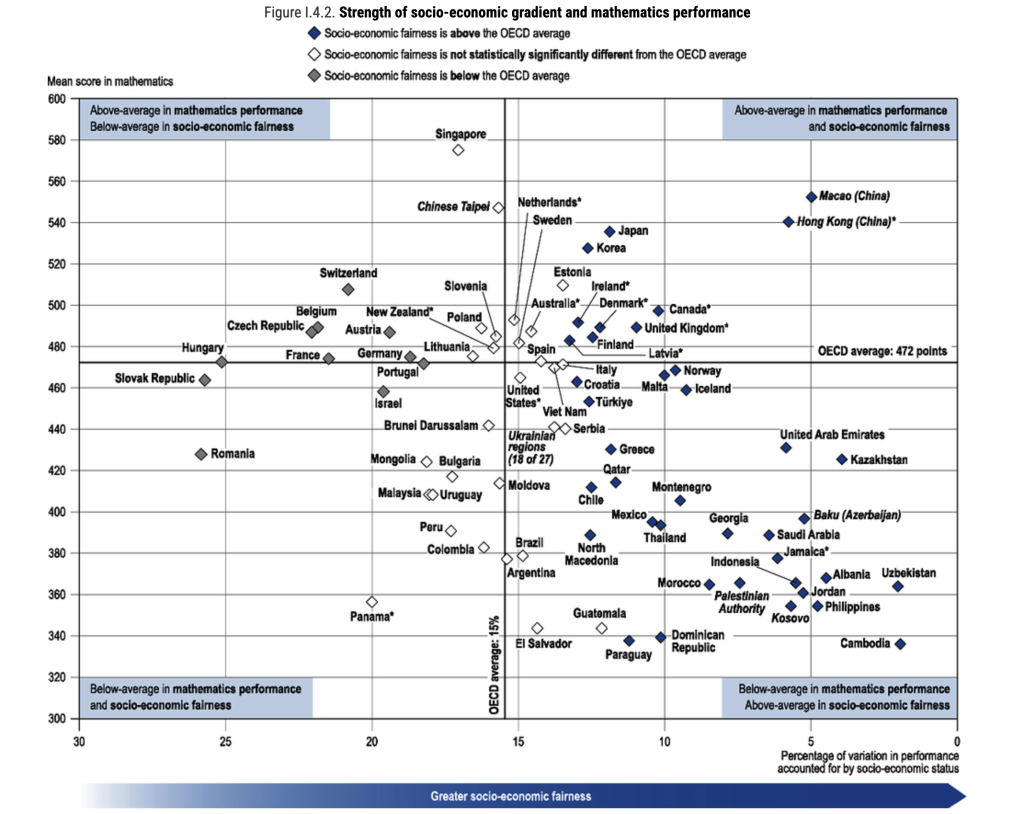
(Source: Equal Opportunity by Student Socio-Economic Status)
So, the United States’ education system is fair, right? For the most part, it is, at least comparative to the rest of the world. While we do see educational achievement gaps along racial lines in the United States, it is partially explainable by socio-economic status and a lack of opportunity in those communities where these students lack support that their peers in well-funded, highly-educated, predominately white suburban areas have.
The US Department of Education Promotes Fairness
That’s right. The reason the US Department of Education (DoEd) exists is to ensure that all students across the nation have equal access to an education. Taken from their mission statement:
Mission
Source: https://www.ed.gov/about/ed-overview/federal-role-in-education
To promote student achievement and preparation for global competitiveness
by fostering educational excellence and ensuring equal access.
State and local governments already wield expansive power to dictate what goes on in our schools. They set the curricula and the standards, and they produce the state-level test. The DoEd is more of a financial backstop for states (~8% of state education budgets), filling more of an advisory function than an administrative one. It leads a national dialogue about how to help improve peformance across the nation and offers insights into what works in education. Generally, the DoEd really only steps in when equal access to education is affected (discrimination). With the smallest staff across all governmental departments, the DoEd can only leverage its substantial budget to influence state and local education systems to ensure equal access to all students.
The Christopher Columbus Method of Academic Achievement
Without a unifying function to ensure consistency and fairness across the nation, it is reasonable to assume that the abolition of the DoEd would drive inconsistency and unfairness into America’s schools. With each state setting its own standards, there will be no concept of an American education. It’ll be 50 different educations, and should some states choose to enact laws that limit a particular group’s ability to access quality education, there will be zero recourse for those impacted.
While the best nations are have demonstrated that national systems and national exams promote higher student acheivement, the United States, under the upcoming Trump 2.0 Administration, is plotting a course in the opposite direction.
This is essentially the Christopher Columbus method of decentralizing education in an effort to achieve national success. Despite failing his mission to find a westward shipping path to India on a pear-shaped Earth, many people believe Columbus found something even better, the New World.
Unfortunately, our New World won’t be so “prosperous.” We will discover, as a result of a failed Trump education policy, that we have become a nation of Americans who lack the education to understand and interpret data, to use critical thinking to distinguish between real and fake, and to understand how the natural world works. We will become the naive, the under-educated, the proletariat George Orwell warned us about. Maybe that’s what Trump wants.
And one more thing…
One other attribute that the top 10 performing nations had in common that the United States fall short on is teacher salary and education. We’ve known it all along, but we don’t pay our teachers enough, and there’s little incentive for those who do take a career in education to achieve higher levels of education. In nations like Japan, a teacher is a respected role in society. In the United States, well, just ask a teacher.